How to capture the most valuable prospects already within reach, but not yet ready to buy
CASE AT A GLANCE
Year2018
RegionUkraine
ServicesSMM, PPC
ToolsFacebook, Instagram
MetricsTransactions, ROI
CLIENT
DEKA
BEFORE THE START
Prior to launching the ad campaigns, the team conducted comprehensive market research, an in-depth target audience analysis, and a thorough audit of the company’s baseline social media strategy and tactics to identify key growth opportunities.
About the ClientDEKA is the undisputed leader in the Ukrainian watch market, boasting a retail network of 45 shops across the country’s major cities, a robust e-commerce platform, and a portfolio of over 60 global brands. With a 34-year track record, the company serves as the official distributor for renowned watch and jewelry labels, earning the trust of more than 500,000 loyal customers. Backed by deep industry expertise, retailer’s consultants possess specialized knowledge of dozens of world-class brands. In 2018, the retailer was honored with the prestigious Watch Ukraine award and continues to actively support high-profile sports, social, and cultural initiatives nationwide.
ContextSMM was already a proven revenue stream for client, generating an average of UAH 90,000 per month. However, a closer look at the traffic structure revealed a significant optimization opportunity: the channel was attracting not only high-intent buyers but also a substantial volume of lower-value audiences. Consequently, the next phase of the project shifted focus from merely increasing traffic volume to maximizing its overall business value.
BriefTransform the social media marketing channel into a high-performing sales tool and increase its profitability.
KPIs & TargetsScale the monthly SMM revenue by 2x and increase the channel’s overall ROI
The ChallengeScale monthly revenue by nearly 2x without increasing the budget for the social media channel. To achieve this, the focus had to shift away from driving more traffic volume toward restructuring the existing traffic. This required eliminating audience segments that were draining the ad budget without converting.
Essentially, the task was to pivot away from low-value traffic and consolidate the budget on discovering high-intent audiences with higher purchasing potential. Fewer low-quality clicks meant a higher share of high-value customers, resulting in increased revenue with zero additional spend.
AudienceThe target segment extended beyond a generic male audience to include men for whom a watch represents far more than a functional accessory. Prospective buyers of high-end global brand models, who prioritize brand reputation, design, premium craftsmanship, and the status tied to their purchase. In this segment, the gap between a casual „interest in watches“ and a „readiness to purchase“ could translate into tens of thousands of Hryvnias in order value.
InsightsMarket research revealed that the primary growth potential was already embedded within the existing audience. For luxury watch models, a social media referral to the website did not automatically indicate immediate readiness to purchase. Instead, behavioral signals proved to be significantly more critical indicators of intent. These included repeat visits, deep engagement with specific product pages, add-to-cart actions, historical purchase data, and the time elapsed from the initial touchpoint to the final transaction.
Evidently, SMM did not always function as a direct, instant-conversion channel. Users frequently engaged with the brand and products multiple times before converting, meaning the channel played a crucial role in assisting and shaping the longer decision-making journey.
“
Fewer random visits. More people who are genuinely ready to buy.
”
Precision over volume: treat every ad impression with the complexity and care of a luxury timepiece.
StrategyThe main focus was placed on audiences with the highest potential for repeat or high-margin purchases, while making better use of demand that already existed. For these users, personalised offers were built around specific brands and products, while the advertising activity was complemented by new-audience acquisition and content designed to maintain interest in the brand, current offers and offline promotions.
WHAT HAD TO BE CONSIDERED BEFORE LAUNCHING?
Business seasonality was factored and audience nurturing was implemented by announcing an ongoing cashback and bonus points promotion.
Advertising materialsTo launch dynamic remarketing, a product feed was prepared in collaboration with the client-side developers team, and the required product data transfer was configured. The campaign was then launched, with separate product carousels created for brands that demonstrated the strongest sales performance.
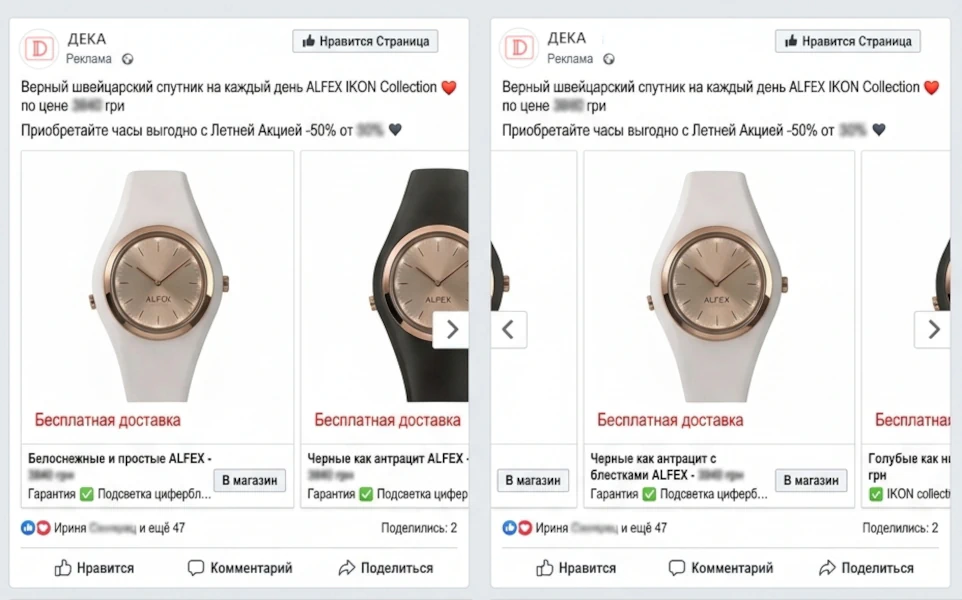
Ad mockup example demonstrating user interface (UI) rendering and visual structure across Facebook network.
Custom advertising copy was prepared for each campaign instead of automatically using product-page descriptions, with free delivery given additional emphasis. At the same time, campaigns targeting new audiences were run alongside promoted posts, current promotions and offline offers.
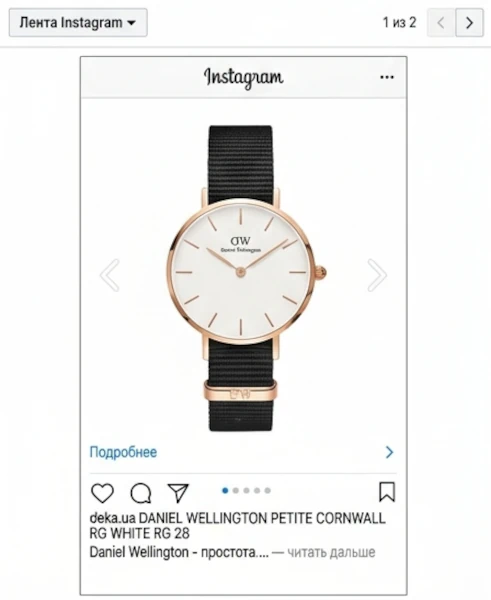
Ad mockup example demonstrating user interface (UI) rendering and visual structure across Instagram network.
ExecutionThe first step was to refine Facebook Pixel data and conversion tracking, building a history of users’ interactions with products for further audience segmentation and remarketing.
Google Analytics data was then analysed to identify traffic sources and purchase paths, the number of interactions with the website, the time from the first visit to the purchase decision, and the role of SMM in conversions.
Based on this data, audience segments with higher potential value were created. These included users who had visited the website at least 50 days earlier, added products to their cart at least twice, had made a purchase within the previous two months, or had a high total purchase value over the full period (LTV).
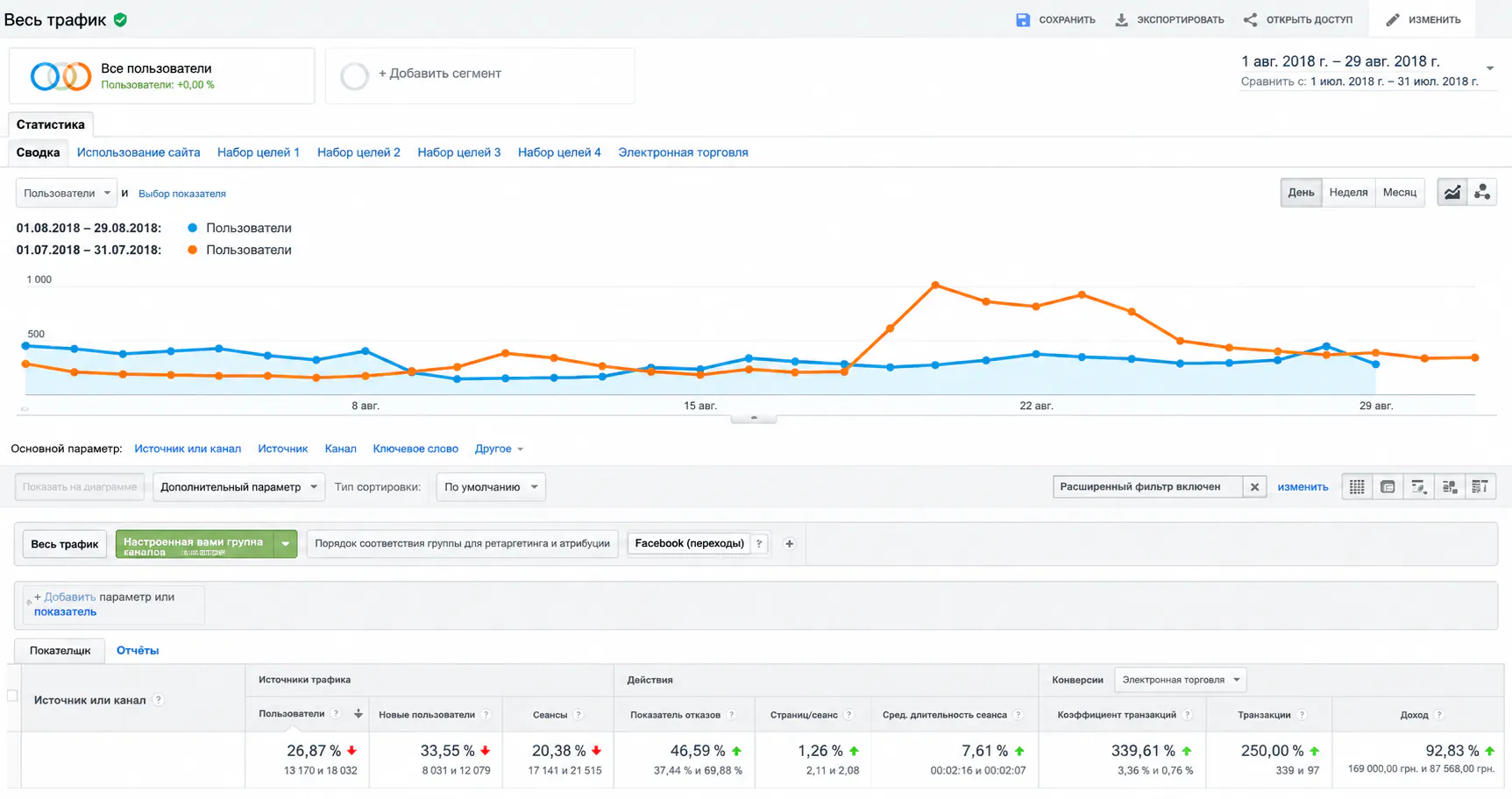
ResultsThe SMM channel ceased operating as a mere volume driver and was transformed into a precision system that concentrated the budget on audiences with the highest commercial value. The main result was a near doubling of monthly revenue, from UAH 89,000 to UAH 169,000, representing +92.83% according to Google Analytics.
Google Analytics report for July–August 2018 with a Facebook|Instagram source / medium filter.
This growth came despite a reduction in traffic volume. Compared with July, August saw a 26.87% decrease in users, a 33.55% decrease in new users, and a 20.38% decrease in sessions.
At the same time, traffic quality improved significantly:
bounce rate decreased by 46.59%;
average session duration increased by 7.61%;
transaction rate increased by 339.61%;
transactions increased by 250%.
Average session duration reached the level of client’s highest-converting channels - SEA and SEO for branded traffic. The simultaneous decline in bounce rate indicated that the website was attracting a more targeted and genuinely interested audience. Dynamic remarketing achieved an ROI of 252%. According to the client, the final net ROI exceeded 200%, including all costs.
↓27%users
↓20%sessions
↑250%transactions
↑93%revenue
What Made the Difference?A fundamental factor behind the success was the strategic decision to stop chasing traffic volume. As a result, the channel’s economics changed:
less incidental traffic;
more targeted interactions;
more transactions;
higher revenue without a proportional increase in spend.
ConclusionDirect conversion during the initial social media touchpoint remains largely characteristic of impulse-buy products. Within a luxury niche featuring premium, high-ticket items, a significantly more effective strategy is to concentrate marketing efforts on the middle and bottom (MOFU & BOFU) stages of the sales funnel - specifically, the consideration and decision phases.
Personal Contribution
Research & Analytics. Comprehensive analysis of the target audience and the brand's market positioning.
Audience Work. Segmentation and development of hypotheses to acquire customers.
Technical Integration. Communication with the client's development team to create and optimize the product feed for dynamic remarketing.
Media Buying. Management and optimization of targeted advertising campaigns across Facebook and Instagram.
End-to-End Analytics. Cross-referencing ad spend and investments to calculate ROI within the client's custom administration panel.
Standard Reporting. Preparation of regular client reports tracking the performance and key metrics of advertising campaigns.